
Interview · 7 min read
Is Every AI Startup Just a Wrapper?
A three-time founder turned AI investor makes the case that the application layer is only beginning—and that great data beats a great algorithm every time.
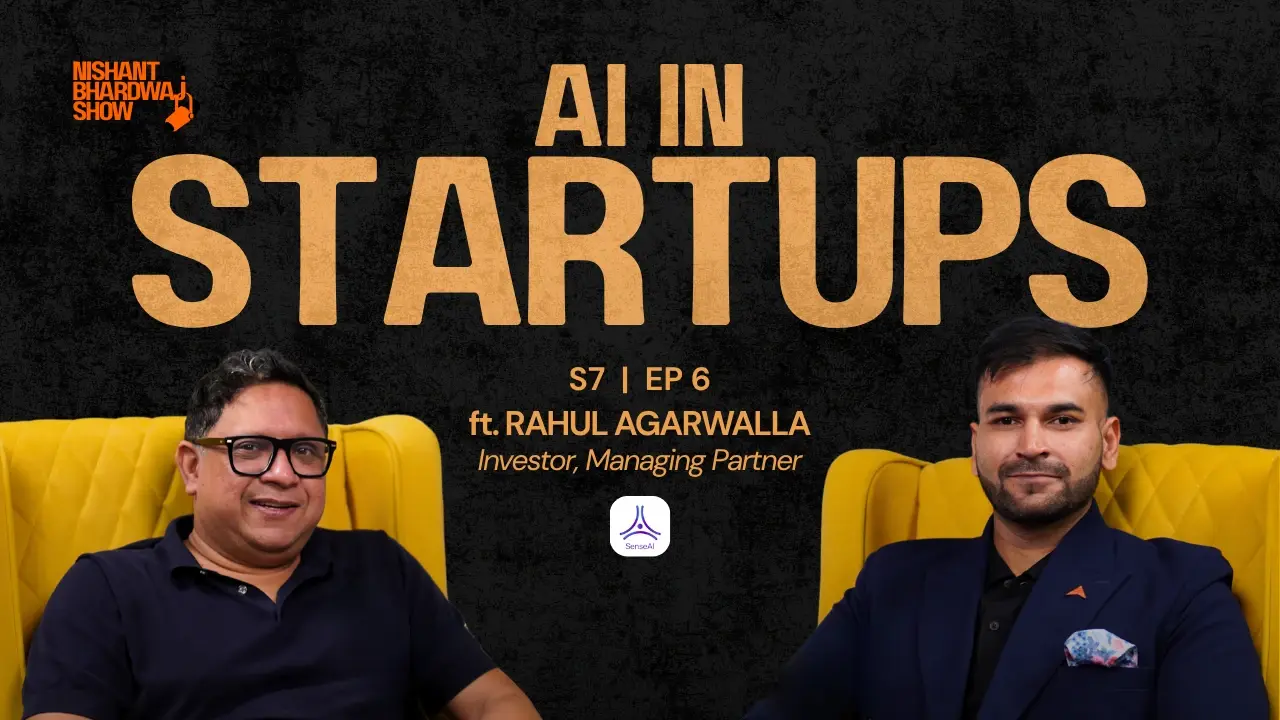
Rahul Agarwalla, managing partner at SenseAI Ventures, is a serial entrepreneur who has built and exited three businesses, a certified scuba diver, a golfer, and, by Nishant's description, a fun and chill guy. What this introduction undersells is the origin story underneath the investing career, one that began not with a thesis about AI, but with a very specific, unglamorous problem: Japanese has no spaces.
The problem that made him a believer
Rahul's previous company, a Japanese big-data business, needed to analyse Japanese text, where sentences run together as long, unbroken strings and a single character can be an entire word. The fix came from a Norwegian computational linguist living in Tokyo, whom Rahul's team found and partnered with rather than trying to build the technology themselves. It worked well enough that Honda, Toyota and Canon became customers. When he sold the company in 2016, the lesson had crystallised: machine learning was the future. If he could not be the builder, the logical move was to find the next exceptional technical founder and back them instead.
A parent, not a decision-maker
That self-awareness shapes how he describes his job now. For the founder, he says, it is their life, so the decisions must always remain with them. The investor's role is supporting and guiding, not deciding. He compares it to parenting: offering years of pattern-matching across markets and customer segments while accepting that whether a founder takes the advice is entirely up to them. His questions in a first meeting are notably not about market size or revenue potential: what problem are you solving, what product are you building, and how does the world change because you exist?
Nobody has a 4K picture of the future
Rahul pushes back on the mythology that great founders see five years ahead in perfect resolution. The picture is hazy and sharpens gradually, often into something different from the original guess. What matters is whether smart founders pivot when it clarifies. He points to Flowwork, which began by saving salespeople time on CRM data entry, then learned that saving fifteen minutes a day was not valuable enough to command a meaningful price. The user stayed the same, but the problem changed: Flowwork now helps generate leads while retaining the CRM integration that made the original insight technically useful.
Why data beats the demo, and why the wrapper thesis is wrong
The sharpest section of the conversation is Rahul's rebuttal to the claim that OpenAI and Anthropic will eventually build every application themselves. Google dominated search and successfully extended into Gmail, Maps and YouTube, but plenty of its other bets did not stick. Management attention does not scale without limit, and no single company can build every business enabled by a foundational technology.
“Great data beats great algorithm every time.”
What he considers the actual moat is data, not model access. Frontier labs have trained on only a fraction of all existing information: the public, digitised internet. The rest sits in private, proprietary or undigitised form, and that is where defensible businesses get built. He traces the pattern through databases, electricity and the early internet: foundational infrastructure becomes essential but invisible, while durable value moves upward to the companies applying it to specific customer problems. Rapidly falling token prices quietly improve the margins of whoever builds that application layer.
How SenseAI actually decides
Last year SenseAI saw 1,263 AI startups apply, met roughly 600 and invested in six. This year, deal flow is on pace to cross 1,500. Of everything the fund has backed, 92 per cent have gone on to raise a follow-on round. Rahul frames that figure as the fund's real value proposition: taking a cheque from SenseAI should materially improve a founder's odds of raising the next one too.
FOMO still exists, but the fund uses a structural defence: it separates the decision to invest in a founder from the decision about price, which is negotiated only once term sheets are on the table. Rahul once offered to back a founder at a four-million-dollar valuation and declined when the founder returned at four times that price; the company was later valued near eighty million. He treats missing the deal not as proof the process failed, but as the cost of maintaining a discipline that works most of the time.
The same conviction shapes how SenseAI treats founders it turns down and those it backs. The fund explains its rejections rather than going silent. In one case, after a co-investor pulled out of a signed round, SenseAI advanced a crore immediately so the company could make payroll while the founder filled the gap. Loyalty, Rahul argues, comes from conviction rather than following what another fund is doing.
The rapid-fire read on where this goes next
Rahul's view of the moment is more measured than either the hype or the backlash. AI is not a bubble, because it already delivers enormous daily value whether or not every use has been monetised. A startup built on OpenAI or Anthropic can still have a genuine moat; roughly 75 per cent of SenseAI's own portfolio calls those models somewhere in its stack. Using the best available tool is not the same as having no defensibility. The quickest rejection triggers are misused technical jargon, an inability to explain the business's numbers, and a lack of ambition.
He expects capital in 2026 and 2027 to keep moving away from infrastructure and token production toward the application layer, where tokens become value someone will pay for. The most important non-technical founder skill is storytelling: making people believe in a future before it exists, followed closely by leadership. His closing message splits cleanly in two: founders should stop waiting for a cheque before they build and test, and enterprises should stop treating AI adoption as a talking point and start investing real money and time.
This piece draws on Season 7, Episode 6 of The Nishant Bhardwaj Show, a conversation between Nishant Bhardwaj and Rahul Agarwalla.
Are We in an AI Bubble? A VC's Honest Take | ft. Rahul Agarwalla | S7 Ep6
S07 · E06 · 1h 14m§ Keep reading
Communities: The Next Big Unlock for AI Marketing?
Moneka Khurana on AI fluency, brand visibility inside LLMs, human judgment, and the collective wisdom marketers need now.
Rewritten: How AI Is Quietly Redrawing Every Industry
Drawing from over 200 conversations with the world's leading operators, scientists and executives, Rewritten is the field guide to the most consequential rewrite of our economy. Coming 2026 from a major publisher.
AI Will Not Replace Humans. Humans Who Use AI Will.
A private equity investor turned operator across Zeta, PayPal, Amazon Pay and AWS makes the case that the real risk in a career was never taking one.