
Interview · 6 min read
AI Will Not Replace Humans. Humans Who Use AI Will.
From private equity to Zeta, PayPal, Amazon Pay and AWS, and now Nugget by Zomato — Vijay Rajagopal on founder qualities, the moat after AI, and the move from Software as a Service to Service as Software.
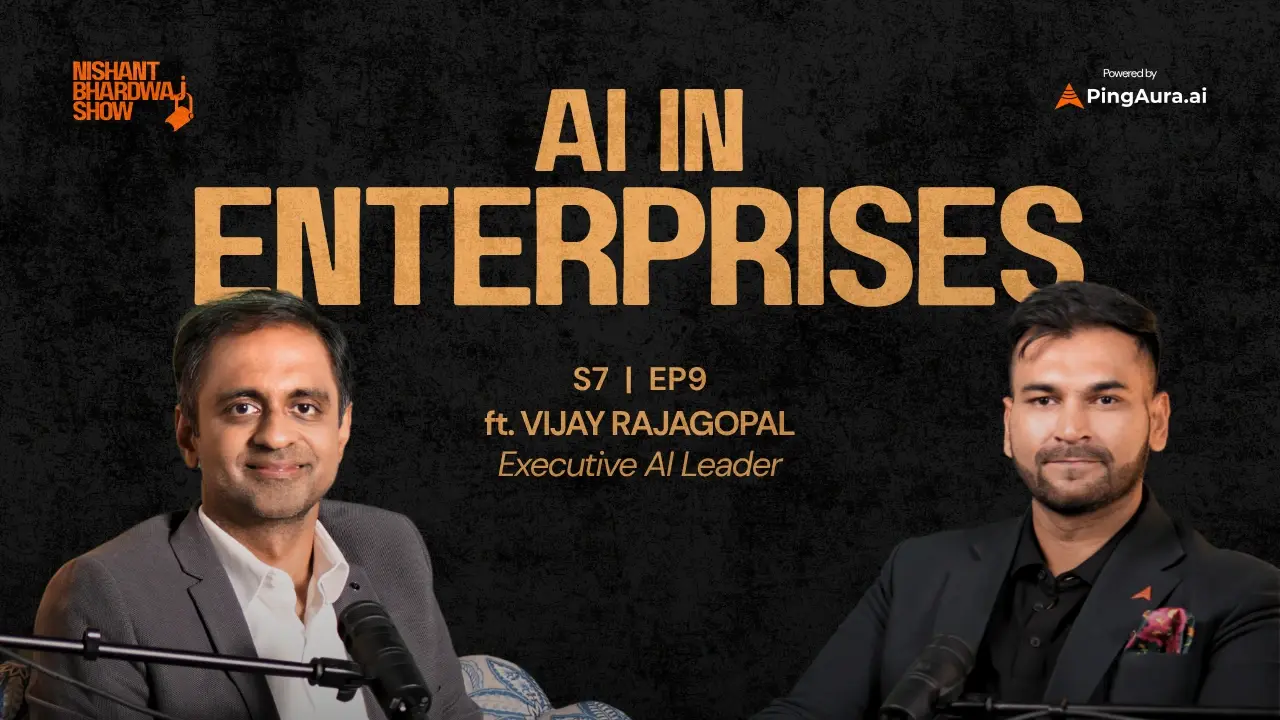
Nishant frames his guest with an analogy that could sound like flattery if the resume behind it did not back it up: SEAL Team Six, purpose-driven specialists with complementary skills, sent behind enemy lines with a mission that has to get done regardless of what goes wrong along the way. Vijay Rajagopal’s career reads like a series of those missions. He started in private equity, sitting on the boards of five companies and watching how they were actually run from the inside. He joined Zeta as a founding leader early in its life, going after a category Sodexo had owned for years in employee benefits. From there to PayPal’s cross-border payments business, then to Amazon Pay, where he built the merchant payments business past $2 billion in transaction volume in under four years. Most recently, Country Head for AWS’s banking and financial services go-to-market, before leaving that success behind entirely to lead growth for Nugget, Zomato’s agentic AI platform.
“I feel the biggest risk one can take in a career is not to take risks,” he says, and he means it literally rather than as a motivational line. The AWS chapter is the clearest proof: he was doing well, enjoying the work, settling into a comfort he describes almost warily. The question that kept surfacing was simply what came next, how much further the envelope could be pushed, and it was uncomfortable enough on purpose that he had to consciously choose it each time rather than drift into it.
“AI will not replace humans. Humans who know how to leverage AI effectively will replace humans who do not.”
Three qualities that separate founders who make it
Asked what actually predicts whether an early founder succeeds in this era, Vijay’s list skips the usual answers about grit or vision. First is learning agility, the ability to learn, unlearn, and relearn on a cycle fast enough that a framework which worked a few years ago, or even a few months ago, cannot be assumed to still hold. Second is recognizing that a business needs a different leader at each stage of its own life: zero to one is hustling toward product-market fit through things that deliberately do not scale, one to ten is about finding repeatability and building baseline systems, and ten to a hundred is an entirely different job, one built around scale, culture, governance, and empowering a team well enough that the business keeps running without the founder personally in every room. Founders who fail, in his account, are usually the ones still leading like it is day one long after the business has moved past it. Third is knowing which questions to ask rather than insisting on having the answers, and then deliberately surrounding yourself with people who know more than you do in their own domain to go find those answers.
The moat, once anyone can ship a prototype in a weekend
Vijay does not pretend the old rules of defensibility still hold. With generative AI making it possible to clone a feature almost as fast as it ships, he argues technology alone stopped being a durable moat some time ago. What replaces it, in his framing, is three things working together. The first is deep workflow integration, a product woven so thoroughly into a customer’s daily operations, their data, their downstream systems, their actual habits, that switching costs become real rather than theoretical. The second is trust, which he calls a slow currency: impossible to build overnight and just as impossible to copy with code, and worth the most precisely in categories like banking and enterprise software where customers are really buying reliability and the assurance that someone will show up when something breaks. The third is distribution, proven channels and go-to-market execution that can beat a marginally better product with none of it, any day of the week.
The empty chair
Pressed on how customer obsession actually gets practiced rather than printed on a wall, Vijay reaches for a specific ritual from his time at Amazon: an empty chair, deliberately left in important meetings, representing the customer who was not otherwise in the room. Its only function was to force a single question before any decision got made: what does this mean for the person sitting there. He sees the mirror image of that discipline constantly in early-stage founders who fall in love with their own model or architecture before they fall in love with the customer’s actual problem. His corrective is blunt: start with the size of the pain, in time, money, or efficiency, solve that outcome first, and let the case studies and growth follow from there rather than trying to reverse the order.
From chatbots to agents, and why Nugget was built where it was
Vijay frames the shift underway as bigger than the chatbot wave that preceded it. Generative AI’s first act was mostly about answering questions and generating text; the real unlock with agentic AI is the move to actually taking action, orchestrating a workflow, and completing complex tasks end to end without a human steering each step. What drew him specifically to Nugget was where it came from rather than what it promises. It was not built in a lab or an isolated research project, it was hardened inside Zomato, Blinkit, and Hyperpure’s actual production environments, handling millions of real-time voice interactions and delivery logistics where latency, accuracy, and tone all matter every single second. Taking infrastructure that has already survived that kind of load and offering it to the broader enterprise market is, in his view, still only the earliest part of what agentic AI ends up doing.
Jobs, and the line he keeps returning to
On the anxiety around AI and employment, Vijay is optimistic without waving away the disruption. Every major technology shift, industrial machinery, personal computers, the internet, eliminated specific repetitive tasks while creating entire industries that did not previously exist, and he expects this one to follow the same shape rather than break it. His sharpest line on the topic doubles as his actual thesis: “AI will not replace humans. Humans who know how to leverage AI effectively will replace humans who do not.” The value that survives automation, in his account, concentrates in three places: critical judgment in situations where the data is incomplete or genuinely ambiguous, the empathy and relationship-building that high-stakes client work and team leadership still require, and the increasingly underrated skill of problem framing, recognizing which problems are actually worth solving in the first place. Treat AI as an intellectual sparring partner rather than a replacement, he argues, and it becomes leverage instead of a threat.
He extends the same logic to enterprise software structurally. The industry is moving, in his words, from Software as a Service to Service as Software: instead of handing a human a dashboard and a database and asking them to do the work, autonomous agents increasingly handle entire vertical workflows themselves, tier-one and tier-two customer support, back-office reconciliation, sales outreach, IT troubleshooting, start to finish. Pricing follows the same shift, moving away from per-seat licensing toward outcome-based and consumption-based models where a customer pays for a resolved ticket or a completed task rather than a seat that may or may not get used, which has the side effect of aligning a vendor’s incentives with whether the customer actually succeeds.
The rapid-fire close
Asked for the book that shaped his leadership thinking most, he names Andy Grove’s High Output Management, for frameworks on leverage and operational discipline he considers timeless rather than dated. The most underrated skill in leadership today, in his view, is active listening, actually hearing a team or a customer rather than jumping straight to a solution already half-formed in your head. What gets him up in the morning right now is the fact that the playbook for agentic AI is being written in real time, on problems that were not solvable even two years ago. And his advice to his younger self skips comfort and titles entirely: optimize for the steepness of the learning curve and the caliber of the people around you, because compounding applies to skills and relationships exactly as powerfully as it applies to capital.
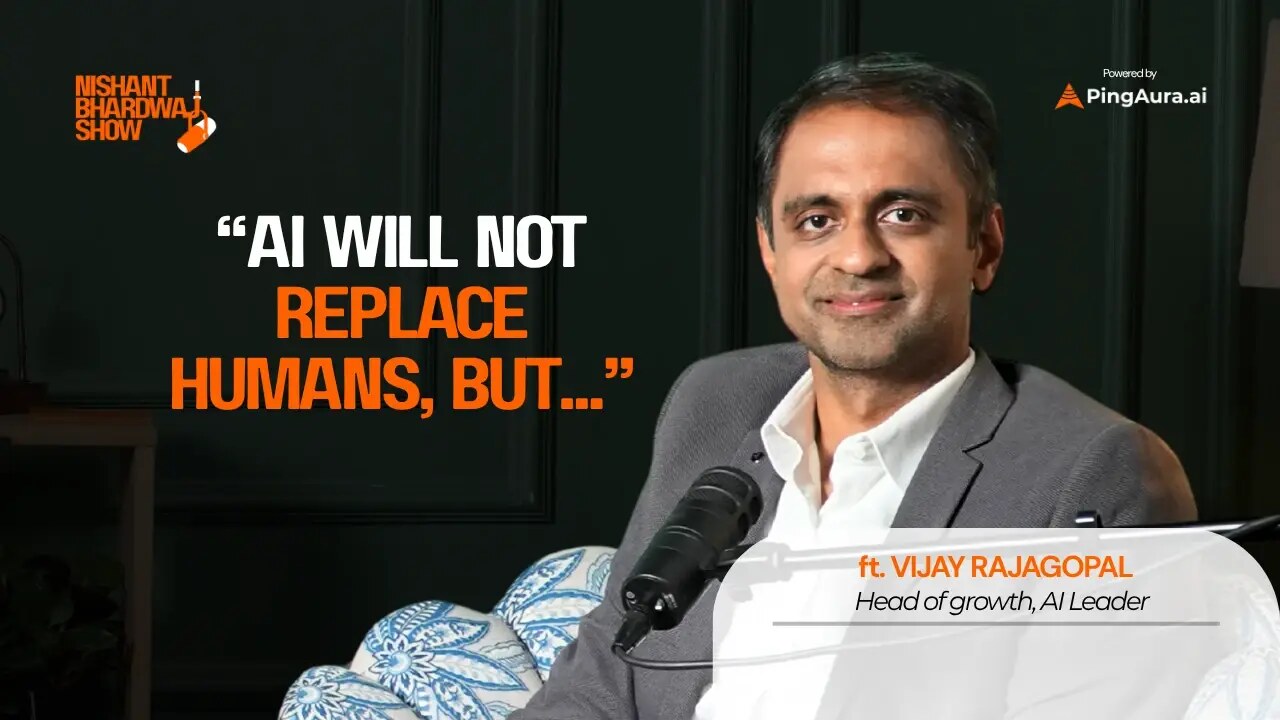
Leaving a Multi-Billion-Dollar Brand to Start Again | ft. Vijay Rajagopal | S7 Ep9
S07 · E09 · 1h 3m§ Keep reading

Every AI Company Is Now a Media Company
The co-founder of Voosh, in his first Y Combinator application, makes the case that when anyone can build the software, the only moat left is how well you actually understand your customer.
Rewritten: How AI Is Quietly Redrawing Every Industry
Drawing from over 200 conversations with the world's leading operators, scientists and executives, Rewritten is the field guide to the most consequential rewrite of our economy. Coming 2026 from a major publisher.

Pressure Is a Privilege
Saina Nehwal on the twenty-five years behind a world No. 1 ranking, the broken knee three days before Rio, and why burnout comes from the wrong work rather than hard work.