
Interview · 11 min read
Communities: The Next Big Unlock for AI Marketing?
A SMARTIES Special with the MMA India managing director on 26 years of digital change, the new rules of AI discovery, and why community is marketing’s next advantage.
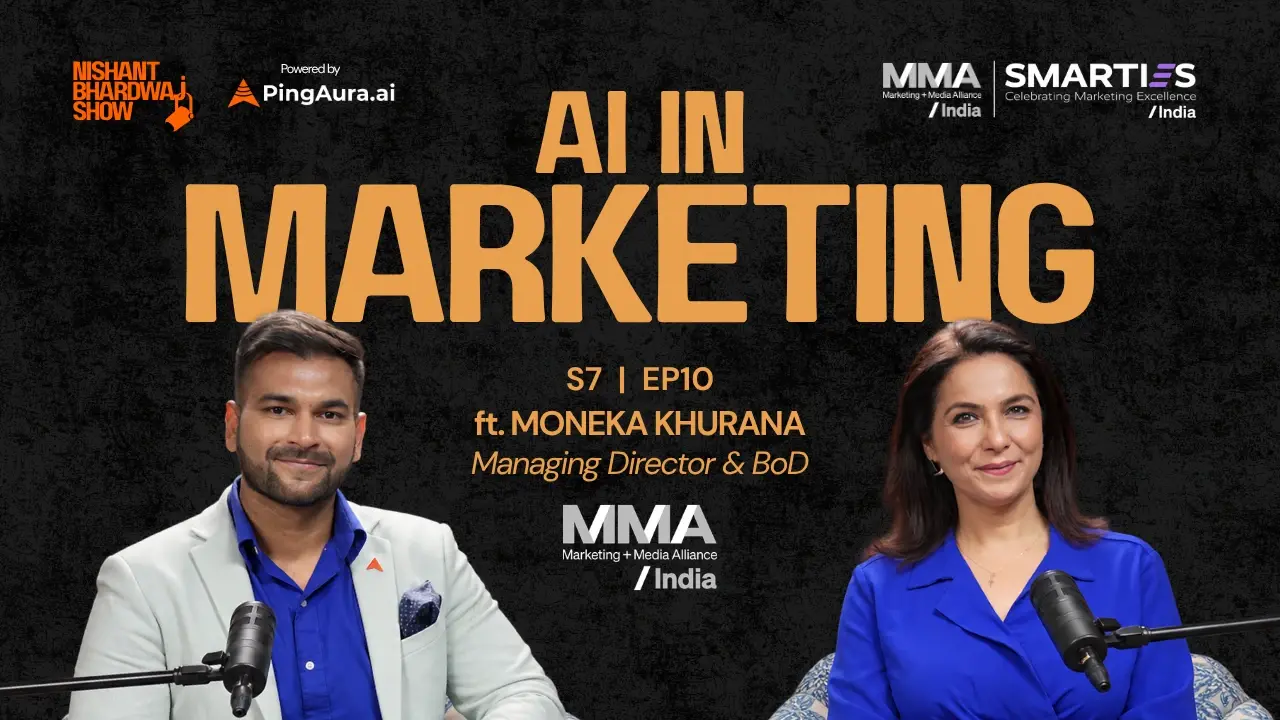
Nishant opens with an analogy he built for exactly this guest: the compass was invented before the clock, which means direction matters more than speed. In a world moving at the speed of AI, he argues, direction becomes what separates brands that last from brands that simply move fast. Moneka Khurana, Managing Director and board member of MMA (Marketing+Media Alliance), has spent 26 years building exactly that kind of direction: lifelong brands, and the communities and leaders behind them.
"26 years just rang a bell for me that, oh my god, it's like almost halfway to 50 years," she says, adding that this is still the best time she's had doing the work. She started as a fresh postgraduate looking for something stimulating and found it in digital, right as the internet itself arrived in India. She remembers logging in through dial-up, watching Hotmail arrive with Sabeer Bhatia as its face, and telling early brands they needed a presence on a new platform called Facebook. She watched Orkut become the Instagram of its moment, and then simply disappear. "All the key journeys in digital, it's been a privilege to be able to see it so closely, not only as a user but as a marketer, as a professional. Been there, seen the boom, seen the bust, and then here we are."
AI fluency, not AI as a gimmick
Asked how she reads this particular wave of change against the five or six she has already lived through, Moneka draws a sharp line between novelty and use. "It's done and dusted that AI was this cool thing which you could sort of open up and generate content and do fun stuff like create Ghibli art. Those are all gimmicks. But the real thing is to really know how to be AI fluent and use it to the advantage of driving business impact." Her framing of the moment: AI is an equaliser, fully democratised, which means the question every organisation actually needs to answer is not whether it has access to the technology but how deliberately it applies that access toward outcomes that matter.
Nishant pushes the implication further, noting that after sitting with roughly 300 CXOs over recent months, he has come to a conclusion he is happy to have challenged: that marketing, not technology, may become the most important function for a company's survival, precisely because as the cost of building the technology itself falls toward zero, individuality, authenticity, and messaging become what actually differentiates a brand to a human customer.
Adoption is uneven, and that is fine as long as the direction is right
On where investment is actually moving between traditional media, digital, and AI-native marketing, Moneka resists a single clean narrative. Some organisations are still watching from a distance. Others, like Mondelez, started their AI journey well before most and have proven what scale genuinely looks like. Most sit somewhere in between, working through what she calls the life stages of adoption. Her caution is specific: the value of AI dilutes fast when it is deployed in departmental silos rather than integrated as an ecosystem across an organisation's functions.
That same distinction, she argues, is what separates CMOs who should worry from CMOs who should not. "CMOs who are very strong with the fundamentals and principles of marketing do not worry about this, because this is just an enabler that is going to help accelerate impact and drive results," she says. The ones who should worry are the ones not building AI into their team as a core skill, not restructuring roles around it. Her bottom line, delivered without qualification: "Judgment continues to be valuable, and the CMO comes with strong judgment that will always play out in the outcome that AI delivers."
Sixty per cent of consumers are already asking the AI first
The clearest, most concrete number in the conversation: roughly 60 per cent of consumers, by Moneka's account, are already going straight to LLMs and AI engines to find brands, ahead of a traditional search or a scroll through social. "If you are not featured or visible there, you are not in the consideration set," she says. The old AIDA funnel, awareness moving to intent moving to desire moving to action, no longer describes how people actually move. A consumer can now jump straight from awareness to action, or from intent to action, skipping stages a traditional media plan still assumes exist.
Being findable inside that shortened path means being genuinely AEO-ready and GEO-ready: content that is structured, verifiable, consistent, and informative, because an LLM is a reader processing what it is fed, and thin or inaccurate content is exactly what it will reflect. Moneka points to a study her team ran tracking brand visibility during the IPL, comparing television against LLMs. Several of the tournament's largest sponsors barely registered inside AI engines, while smaller brands that specifically invested in LLM visibility during the same window captured an outsized share of it. Her conclusion is blunt: sponsoring a mainstream event does not exempt a brand from doing the foundational work required to be visible and searchable to an AI system.
Nishant extends the point to a structural shift in who marketing is actually speaking to: brands now have to communicate not just to human audiences but to autonomous agents that fetch and synthesise structured data, schemas, reviews, and ratings on a person's behalf, often in real time.
The paid layer is arriving, and it will echo SEO and SEM
On whether conversational AI placements become a genuine revenue channel rather than a novelty, Moneka sees the pattern already forming. Platforms are actively rolling out ad formats inside conversational interfaces, and major brands and agency networks are already testing them. "It follows the classic parallel of SEO and SEM," she says: organic AEO and GEO work as the foundation, paid AI placements layered on top, with brands needing depth across multiple models, including regional and culturally specific ones, to avoid missing entire consumer segments. She expects LLMs to follow a trajectory close to what retail and quick-commerce platforms have already been through, evolving from pure discovery or commerce channels into full-funnel marketing ecosystems in their own right.
Reflecting on recent jury conversations with CXOs and CMOs across MMA's community, she names three live tensions the industry is actually working through right now: the collapse of full-funnel marketing into a single, faster cadence as retail media and quick-commerce blur research and purchase into one motion; the fight to preserve brand recall and cultural resonance as attention fragments across an ever-growing number of platforms; and the deeper, harder question of proving marketing's contribution to enterprise and financial value in terms a board actually accepts, beyond the generic debate about whether AI is coming for anyone's job.
Why Smarties exists, and what Unplugged adds to it
Moneka describes MMA Smarties as sitting deliberately at the intersection of creativity, effectiveness, technology, and business impact, judged in its final round entirely by a cross-category jury of working marketers rather than a closed panel, which turns the process itself into something closer to a masterclass. Smarties Unplugged, the companion event, exists to decode the work the Gala recognises: bringing the ecosystem together to discuss the thinking behind the winning and finalist campaigns, timed deliberately as preparation for the festive season and the new financial year ahead.
On AI versus human creativity within that judging lens, her framing stays consistent: human-led, AI-assisted, whatever the audience. She points to Titan's Made in India OTT series as an example of storytelling that connected first through narrative before extending into retail, and to The Whole Truth as a case where founder authenticity and product genuinely reinforce each other. For founders and startups without large budgets, she argues creative storytelling remains a real equaliser, rewarding a sharp idea and audience clarity over production spend.
At Smarties Unplugged this year, MMA is also releasing AI 101, a resource built directly to close what Moneka calls the gap between theory and application: real case studies and use cases marketers can actually borrow from and act on, built with input from MMA's own member community, board, and AI council.
The agent stack she is actually building
Asked what she personally is building rather than simply advocating for, Moneka names three agents in progress: a Member Intelligence Agent that gives her team real-time, context-specific insight; a Chief of Staff Agent, wired into her communication channels, whose job is to keep her time pointed at the industry's highest-value problems; and a Research Agent, meant to make MMA's own accumulated body of applied research genuinely discoverable rather than locked away. Nishant, visibly taken with the Chief of Staff idea, offers his own team's numbers in return: PingAura currently runs roughly 60 agents against nine or ten humans, with the large majority of its coding already AI-assisted, and a set of research agents (LinkedIn, Reddit, and Quora among them) coordinated by a single orchestrating agent across marketing and sales.
Give Gen Z a seat at the table
On integrating Gen Z and Gen Alpha, the generations she says now set pop culture before it becomes pop culture, Moneka's answer returns to the same discipline she applies to customers: the empty chair. "It's time to recognise that Gen Zs need a seat at the table," she says. "We cannot follow a hierarchy where we only look at it from a standpoint of eligibility." As the parent of two Gen Zs herself, she offers indie wild, a Gen Z skincare and haircare brand, as a case study in getting this right: Instagram-first, founder-forward, built around creator content and real-world events rather than a traditional television campaign, including reviving the old-fashioned champi head massage as a hosted event format that genuinely lands with its audience.
She and Nishant close that thread on the relationship between incumbents and insurgents: large legacy brands carrying deep resilience and long-built distribution, younger brands carrying agility and cultural relevance, and MMA actively pushing both sides to trade what the other one has.
The rapid-fire close
Asked whether AI is making marketing better or simply producing more slop, Moneka's answer is conditional rather than absolute: in the hands of able leaders, it makes marketing better; used as a gimmick, it turns into trash. She would award a strong AI-generated campaign without hesitation, "because there's still a human behind it; at all points in time it's human-guided and AI-assisted." Asked to rate agent-led marketing against human-led marketing, she calls them equal, arguing the era demands doing a good job at both rather than choosing one.
On whether 2030 brings an Agent CMO instead of a human one, her answer arrives with no hedge at all: "Never. No, never." Pressed on why, she is precise: "An Agent CMO can never deliver on judgment calls and on consumer insight. It can never be a synthetic process. So you'll always need a human CMO; the Agent CMO can be a great co-pilot." Asked where the lifelong advantage in a career actually sits, ideas or data, she splits her answer into three parts: staying curious and coachable first, letting data act as a compass for sharpening ideas second, and sharpening the ability to ask genuinely good questions third, calling that skill itself a direct upgrade to leadership.
On the marketing tasks AI should fully own end to end, her answer is unambiguous: all forms of optimisation and anything genuinely repetitive. Asked about Pocket FM, the AI-generated audio fiction platform that reached a 500 million dollar ARR, she reframes rather than concedes the point: "There was still a brain behind that creation." Her single most-repeated instruction to marketers throughout the conversation resurfaces here as her answer to the one capability every marketer needs to build now: the discipline of asking better questions, because every model will hallucinate eventually, and the ownership for what comes out still sits with the person who asked. Her own daily tools: Claude, a note-taking tool called Granola she is newly exploring, ChatGPT as a regular second opinion, and Gemini still on her list to dig into properly.
Her one word for 2026 and 2027: accountability, paired with business impact.
Back to school, together
Asked what she would tell a billion people watching, Moneka returns to the theme that runs under everything else she said: community. "This is one time where we need to dip into collective wisdom," she says. "Do not guard your learnings or remain proprietary about it; share it openly." Her closing framing of the moment doubles as advice and as warning in the same breath: "We are all back to school now, we are starting from scratch, and it's a new way of doing things, just the way COVID taught us so much." For anyone choosing to sit this one out, her line is direct: AI is democratizing knowledge and expertise, and authority no longer belongs automatically to whoever holds the most experience. It belongs to whoever is actually willing to use it.
Know why the work that won actually won
SMARTIES Unplugged brings the ecosystem together to decode the campaigns recognised at this year's Smarties Showcase, straight from the winners, the finalists, and the jury that judged them. It is part masterclass, part planning session, timed right before the festive season and the new financial year hit. If this conversation with Moneka made the case for going deeper, this is where that happens.
Register for SMARTIES Unplugged
Learn more: MMA Global · SMARTIES · SMARTIES on LinkedIn · MMA Global India on LinkedIn
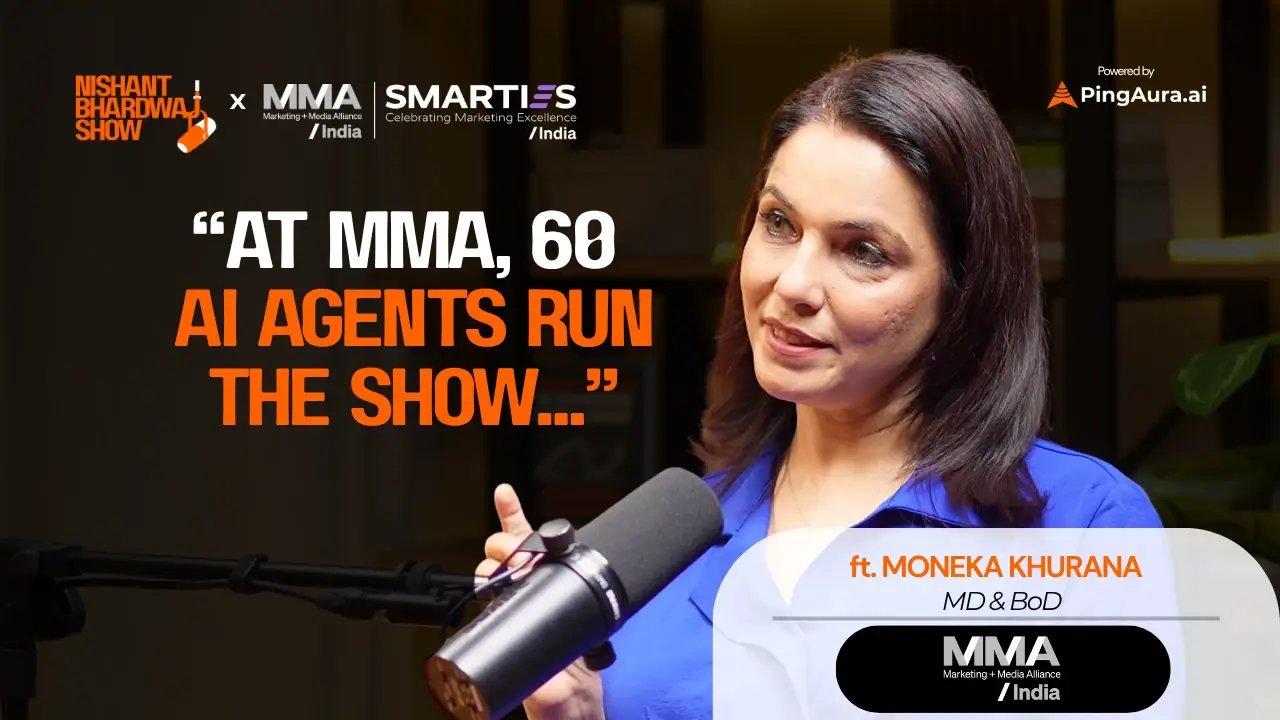
Should CMOs Fear Being Replaced by AI? | ft. Moneka Khurana | S7 Ep10
S07 · E10 · 1h 12m§ Keep reading
AI Will Not Replace Humans. Humans Who Use AI Will.
A private equity investor turned operator across Zeta, PayPal, Amazon Pay and AWS makes the case that the real risk in a career was never taking one.
Rewritten: How AI Is Quietly Redrawing Every Industry
Drawing from over 200 conversations with the world's leading operators, scientists and executives, Rewritten is the field guide to the most consequential rewrite of our economy. Coming 2026 from a major publisher.

Every AI Company Is Now a Media Company
The co-founder of Voosh, in his first Y Combinator application, makes the case that when anyone can build the software, the only moat left is how well you actually understand your customer.