
Interview · 7 min read
Is AI a Safe Medium for Enterprise Marketing?
A three-decade marketing veteran who moonlights as a marathoner makes the case that in the AEO era, getting found isn’t the goal anymore. Getting recommended is.
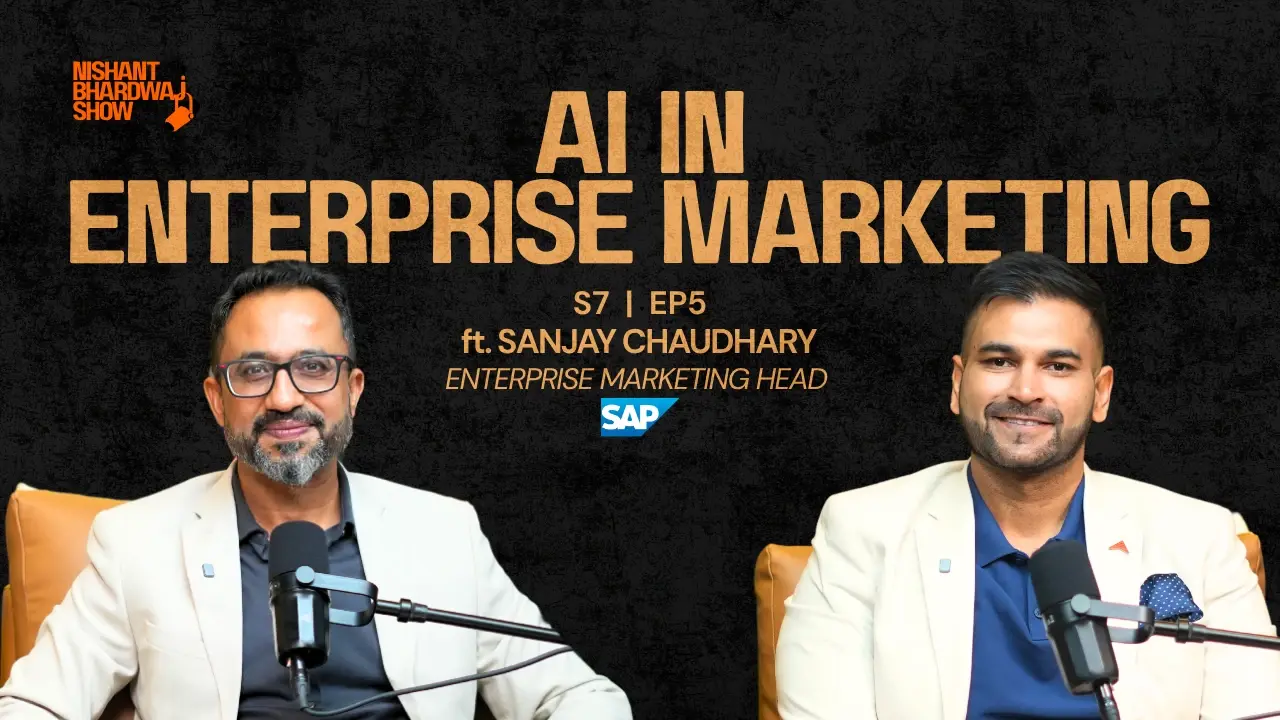
“Chief Marketing Officer will also be a Chief Agent Officer,” a one-liner promise, cut together with the episode’s real thesis: “In the AEO world, search is not important; getting found is not important. What is more important is getting recommended.” Sanjay Chaudhary is currently Head of Enterprise Marketing at SAP, with stints before that at Oracle, Intellect Design, the fintech startup Lentra, and American Express.
Sanjay calls himself a nonlinear marketer, having moved from marketing communications into sales strategy and operations before returning to marketing full time, and he opens with an analogy he and Nishant share a genuine passion for: running. “You have to plan the whole strategy for the run, exactly the way you put together your GTM strategy,” he says. “The finish line is your revenue, but you have to work backwards. Without nutrition, you cannot perform, and that is your sales collaboration. But you cannot just one day decide and go start running. What you need is a lot of mileage before that, and that is what is brand and trust.” Building a brand, in his framing, is functionally identical to building fitness: both require showing up at the same time, in the same way, for years before the result is visible. “You can’t build brands with inconsistency.”
The three Rs, and a startup that out-punched its budget
Asked what actually makes an event successful, Sanjay resists the obvious answer. Too many marketers treat the event itself, what he calls “the last mile”, as the whole job, when the real work is the nine yards that come before it: deep insight into the audience, a narrative built around their actual pain points, and a roster of voices beyond the company’s own. Running a series of finance and fintech events across four cities, he made sure 60 per cent of the speakers on stage were not from his own company. Success, in his accounting, comes down to three Rs, in order: revenue first, then relationships, then reputation, except that the causality actually runs backwards. “Reputation brings relationships, and then relationships bring revenue. It’s not the other way around.”
The clearest proof of the model came at Lentra, a fintech startup with a fraction of an enterprise marketing budget. Sanjay built what became the Lentra Digital Lending Summit by convincing the startup’s own technology partners that promoting the event served their interests too, since it brought them the same banks and NBFCs they were trying to reach. Roughly 60 per cent of the cost ended up being carried by those ecosystem partners. The event drew 600 senior executives, 220 of them CXOs, including leadership from the State Bank of India and the Aditya Birla Group, to something that was, on paper, a small fintech’s user conference. “It wasn’t about Lentra anymore,” he says. “It was about the entire industry coming together to paint a vision of what it means to do digital lending.” He applies the same scepticism to account-based marketing generally: his litmus test for whether a program is actually personalised is simple: remove the account’s name from the messaging, and see if it still only makes sense for that one customer. If it reads as generic with the name removed, it was never ABM to begin with.
Getting recommended matters more than getting found
The episode’s sharpest material comes when the conversation turns to AI search directly. Sanjay’s read on where SEO ends and AEO begins is unusually precise: in traditional search, a brand controlled roughly everything, its website, its ads, its own channels. In AI search, he estimates only 30 per cent of what shapes a recommendation is still on-page and within a brand’s control; the other 70 per cent is off-page: the trust signals, editorial coverage, and third-party validation an AI system weighs before it will recommend anything at all. “It becomes a trust engine,” he says, one that discounts a brand’s own claims about itself precisely because it assumes a brand will only ever say positive things about its own product.
“In the AEO world, search is not important; getting found is not important. What is more important is getting recommended.”
The numbers he cites for why this matters are blunt. Among Indians aged 15 to 35, roughly 250 million now use ChatGPT or Perplexity as a primary source of information, he says, and even enterprise buyers drafting RFPs are turning to the same tools. A brand absent from an AI system’s recommendation set does not get a chance to lose the deal on merit; it never enters the room. He extends the logic further than most marketers are willing to: agents, in his view, are becoming a customer category in their own right, alongside humans, and by his estimate there could be more than 10 billion of them online by 2030, a customer base with no interest in colour, storytelling, or brand feel, only facts, structured data, and verifiable trust signals. Treating that audience the same way a brand treats human customers, he argues, is a losing strategy.
Every marketer becomes a manager of agents
Sanjay frames the coming shift in marketing organisations around three layers. The first is a data foundation, making sense of scattered customer and intent data faster than was previously possible. The second is execution, content generation and campaign orchestration, which is already accelerating past the pilot stage. The third, strategy, is the layer he insists does not automate away: knowing what question to ask in the first place, since a wrong question reliably produces a wrong answer no matter how capable the system answering it is. His summary of where that leaves the org chart is direct: “Every person, no matter how many years of experience, will be a manager, because the person will be managing agents. Chief Marketing Officer will also be a Chief Agent Officer.” What does not change, in his account, is empathy, authenticity, and the discipline of asking better questions, the parts of the job AI has no access to regardless of how good it gets at the rest.
Advice for the people actually running the department
For CXOs trying to future-proof themselves, Sanjay offers a personal rule: 70 per cent of time on the job itself, 20 per cent on continuously upskilling, and 10 per cent given back to the wider community. On team structure, he reaches for an F1 car: marketing is the engine, the CEO is the driver, strategy is the steering, sales is the front wheels, and operations and customer success are the back wheels, none of it functional in isolation. Asked how a founder with no brand and no budget gets their first ten paying customers, his answer skips the tactics entirely and goes to sequencing: find one customer, work backwards from making that single customer successful, and let their advocacy do the work of finding the next ten. “The one or two customers in the initial stages can bring you ten, ten to a hundred, a hundred to thousands.”
The episode closes on a rapid-fire round that mostly resists easy answers. AI will not take marketing jobs, in his view, though it will absorb the execution layer entirely. SEO is not dying, only shrinking as a share of the whole. An AI agent, he believes, cannot yet close a million-dollar enterprise deal, because trust still has to be built through credibility and intimacy that digital content alone cannot manufacture, not yet at least. And to the question of why every marketer should run a marathon, his answer loops back to where the conversation began: discipline transfers. “A healthy mind only lives in a healthy body,” he says. “Right eating and right exercising are a form of self-respect.”
AI in Enterprise Marketing: How SAP Approaches AI at Scale | ft. Sanjay Chaudhary | S7 Ep5
S07 · E05 · 52m§ Keep reading
Communities: The Next Big Unlock for AI Marketing?
Moneka Khurana on AI fluency, brand visibility inside LLMs, human judgment, and the collective wisdom marketers need now.
Rewritten: How AI Is Quietly Redrawing Every Industry
Drawing from over 200 conversations with the world's leading operators, scientists and executives, Rewritten is the field guide to the most consequential rewrite of our economy. Coming 2026 from a major publisher.
AI Will Not Replace Humans. Humans Who Use AI Will.
A private equity investor turned operator across Zeta, PayPal, Amazon Pay and AWS makes the case that the real risk in a career was never taking one.