Interview · 7 min read
Evolution of AI in Medicine
A breast cancer surgeon who took up triathlons at 41 makes the case that AI’s real value in medicine looks a lot like its value everywhere else: sharper questions, not fewer humans.
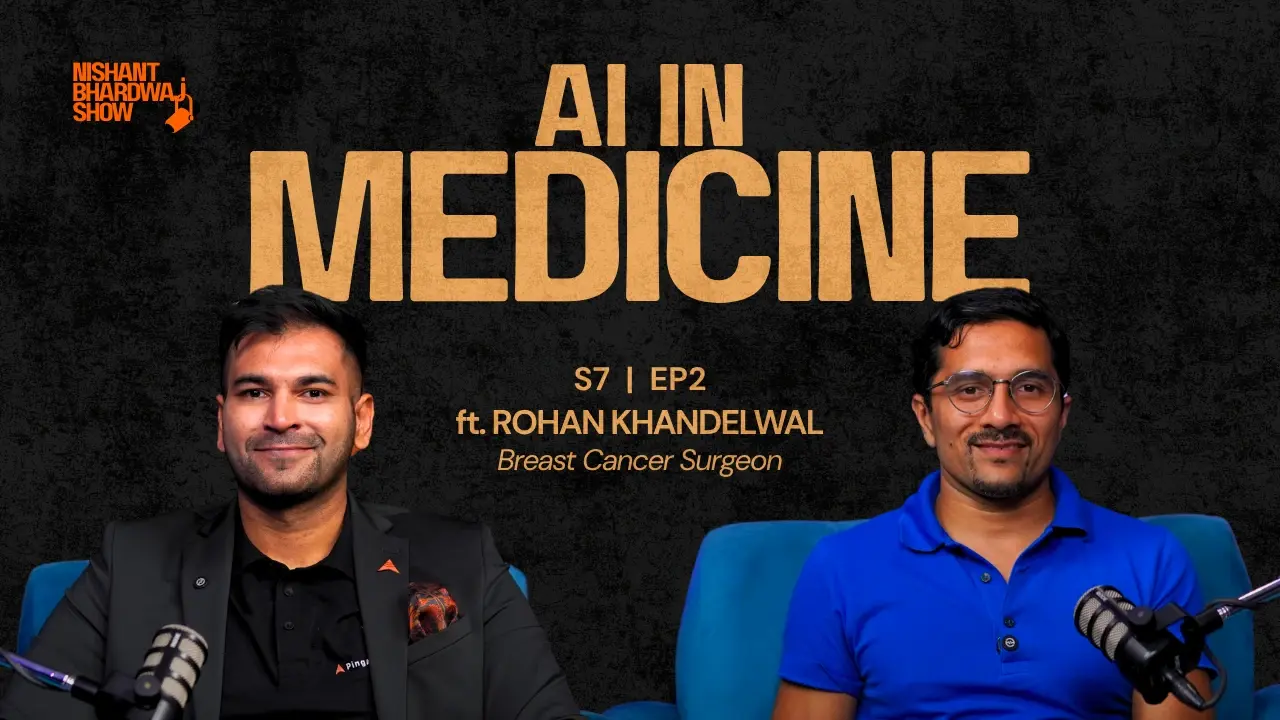
Season 7’s second episode opens the way the first one did, with the takeaways before the introductions. In the opening minutes, Dr Rohan Khandelwal previews the ground the conversation is about to cover: AI is already changing the questions patients bring into a consulting room, data is becoming as important to understanding a patient’s health as the exam itself, and neither of those facts means a doctor can hand judgment over to a chatbot. He mentions using ChatGPT, Claude, and Perplexity himself, and is direct about the limits: AI can hallucinate, and it is not a substitute for the medical textbooks a doctor’s training is actually built on. The opening also lands, deliberately, on a harder note: frontline healthcare workers in India still don’t have the safety a job like theirs should come with.
That range, technology and its limits sitting right next to the human cost of a broken system, turns out to be the register the whole episode operates in.
The surgeon who became a triathlete at 41
Dr Rohan is a breast cancer surgeon and an “Iron Man” finisher, and the biography behind that pairing is worth the detour it gets. He comes from a family of doctors who pushed sports alongside medicine from early on, and like most people, he noticed his metabolism starting to shift past 35. The real turning point came at 40, when his parents gave him a fitness tracker as a gift, small enough that it reads almost like a family joke, except it’s the moment his approach to his own health became data-driven rather than assumed. A year later, at 41, he started competing in triathlons, describing the pursuit in terms of wanting to “reverse age” rather than simply stay fit.
The lifestyle conversation that follows is where he’s most direct. He argues there is “no safe limit” for alcohol or smoking, and flags a specific gap in awareness among Indian women, who may lack certain enzymes that let the body process alcohol as efficiently as it’s often assumed to. “Fatty liver” is becoming common, he notes, and he sees a widening split forming between people building health-focused habits and people still embedded in heavy “party cultures.” Fitness, in his framing, compounds quietly, and mostly out of sight, until the effect becomes impossible to ignore.
Breast cancer, and the awareness gap around it
The conversation’s most direct public health message comes here: breast cancer is now the most common cancer among Indian women. Dr Rohan explains why early detection is harder than it should be: early lumps are frequently painless, which is exactly why they get neglected until later. He runs through the risk factors: genetics, obesity, smoking, and delayed childbearing past 30, and is candid about the factors that resist easy measurement, pollution and stress being the two hardest to quantify, even though both are widely believed to play a role.
Where AI actually helps, and where it still can’t
On the technology itself, Dr Rohan’s view is consistently narrower and more specific than the AI-hype version of this conversation tends to be. AI has been used in mammogram detection since 2014, well before the current wave of attention, primarily to help radiologists flag areas worth a second look. What’s changed more recently is the patient on the other side of the table: people now arrive with more refined questions, because they’ve used AI themselves to summarise a previous visit or research a diagnosis before walking in. On the treatment side, “next-generation sequencing” is opening the door to more personalised care, though he’s clear that it’s still expensive and needs more standardised data before it scales.
Looking further out, he points to startups like Neco Health, working on full-body scans, and Mistral AI’s imaging models as signals of where diagnostic tools are heading. For medical students specifically, his advice is practical rather than sweeping: use AI to build personalised study plans and “virtual logbooks” that summarise clinical cases, but don’t let it substitute for the foundational book learning that still has to happen. He would like to see an AI course formally added to the MBBS curriculum, treating it as a skill to be taught deliberately rather than picked up informally.
Productivity, jobs, and the infrastructure AI can’t fix
Nishant brings up newer productivity tools, including one called Neo Sapiens for summarising offline meetings, and Dr Rohan shares his own approach to multitasking and time management around a surgeon’s schedule. On the broader fear of AI displacing jobs, his take is measured: some short-term displacement is likely, but he expects new roles to emerge in its place, on the condition that people are willing to upskill rather than wait it out.
The conversation turns more serious on the subject of frontline safety, referencing a recent incident in Maharashtra as a starting point. Dr Rohan is clear that the structural problem is a lack of resources and hospital beds, an administrative failure rather than anything doctors themselves are responsible for. He notes that the technology gap between India and the West has narrowed to roughly two to three years, but affordability, not access to the technology itself, remains the biggest barrier to closing what’s left of that gap.
The gap nobody has closed yet
Dr Rohan closes on the opportunity he sees most clearly from the inside: no platform in Indian healthcare currently “closes the loop” from booking an appointment through surgery and into follow-up care. He encourages founders to build AI tools that can summarise a patient’s data before they even reach the OPD, and mentions that he has put his own money behind that bet, as an active angel investor in medical AI startups including Curium and HexaHealth.
He leaves the conversation on the line that ties the episode’s two halves, medicine and fitness, back together.
“AI cannot exercise for you. You have to get up and do it.”
This piece draws on Season 7, Episode 2 of The Nishant Bhardwaj Show, a conversation between Nishant Bhardwaj and Dr. Rohan Khandelwal.
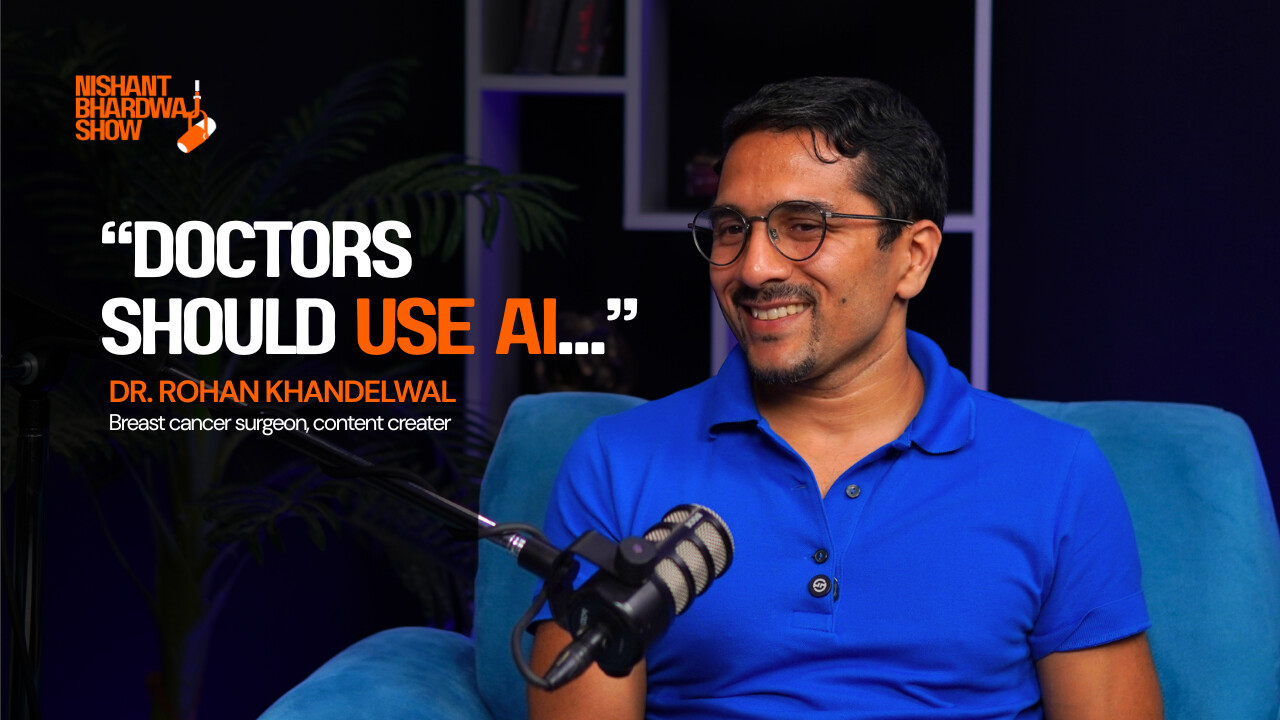
Evolution of AI in Medicine | ft. Dr. Rohan Khandelwal | S7 Ep2
S07 · E02 · 51m§ Keep reading

Every AI Company Is Now a Media Company
The co-founder of Voosh, in his first Y Combinator application, makes the case that when anyone can build the software, the only moat left is how well you actually understand your customer.
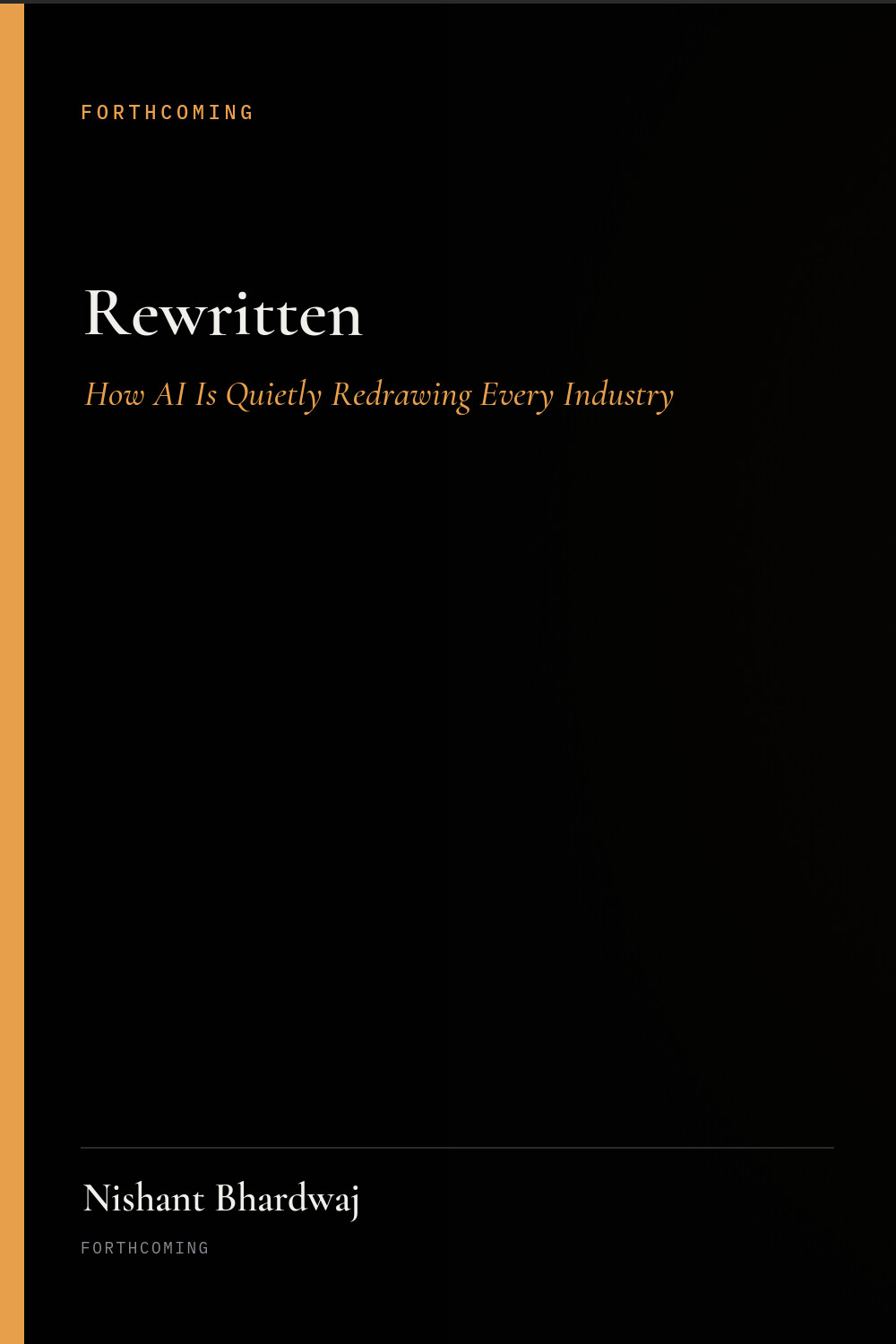
Rewritten: How AI Is Quietly Redrawing Every Industry
Drawing from over 200 conversations with the world's leading operators, scientists and executives, Rewritten is the field guide to the most consequential rewrite of our economy. Coming 2026 from a major publisher.
Pressure Is a Privilege
Saina Nehwal on the twenty-five years behind a world No. 1 ranking, the broken knee three days before Rio, and why burnout comes from the wrong work rather than hard work.