
Interview · 7 min read
Can AI Win Wars? Future of AI in Defence
Major General Vikram Dev Dogra, with 40 years in uniform and three Iron Man finishes since retiring, makes the case that AI wins wars the way it wins everything else: faster decisions, not fewer people.
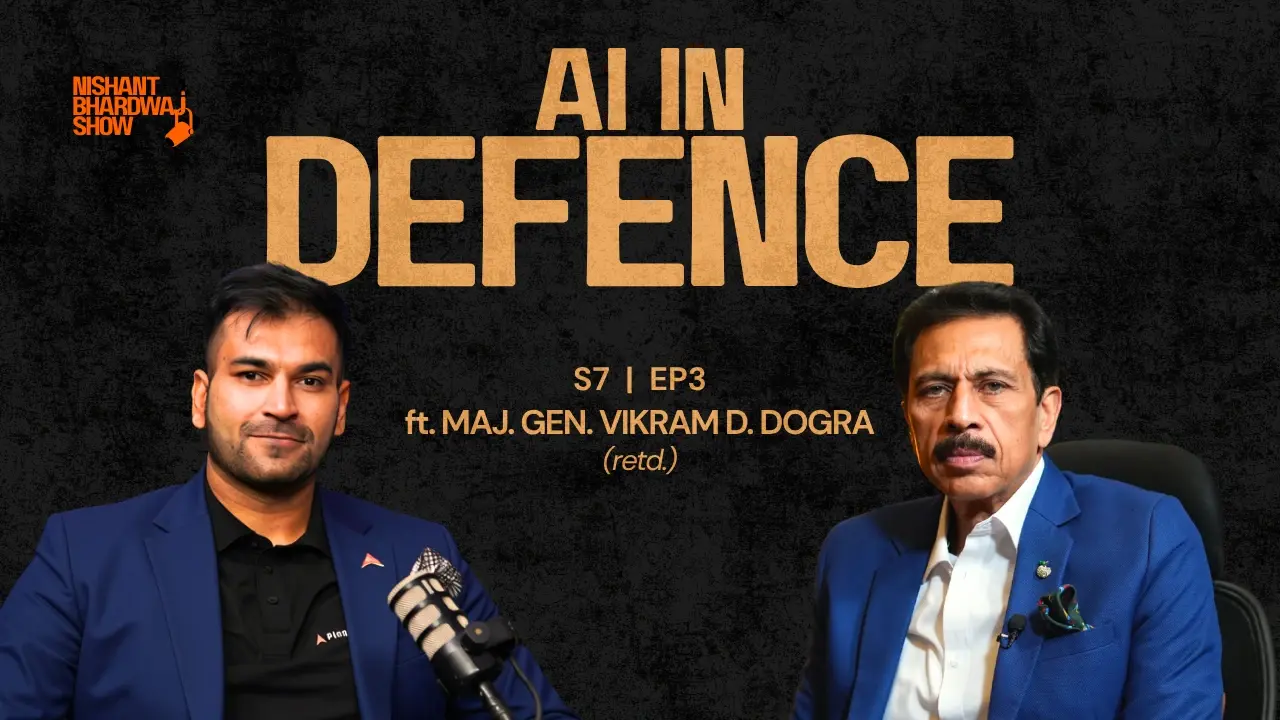
“What is the future of AI in defence, and should India be looking at building their own capabilities going forward?” Nishant asks. The answer comes back immediate and unhedged: “I think AI must be incorporated into defence. It already is.” Between those two lines sits everything the episode goes on to unpack: drones breaching defensive shields, startups trying to get a foot in the door with the armed forces, and the line Major General Vikram Dogra returns to more than any other: “People think that when AI comes in, the human goes out. No, AI will only assist in the decision-making.”
The decision loop AI actually speeds up
Dogra, who spent forty years in the Indian Army before retiring as a Major General, frames the entire AI-in-defence question around one idea: decision-making speed. Going into battle, or preparing for it, intelligence arrives from everywhere at once: human sources, signal intelligence, drones, aircraft, satellites, “the whole plethora of people who are giving you intelligence.” Collecting and processing all of that manually is slow and error-prone. AI compresses it. “The faster the person who can make the faster decision will always be the winner in war,” he says, because by the time a slower opponent has processed the same information, the faster side has already acted on it and moved on to the next decision.
What AI doesn’t do, in his account, is take the human commander out of that loop. “Whilst AI comes in, the human commander does not go out,” he says. “AI is only to assist. AI is not replacing.” He describes moments where the machine’s recommendation and his own read of the ground disagreed, and the ground won: “My gut instinct tells me I’m on ground. I should do this. That is where I need to overrule AI, because AI can’t be correct always. AI is only an input.”
Where the actual startup opportunity sits
Asked where founders should be looking, Dogra points first to drones. “Drones have been able to penetrate defensive shields,” he says, describing their use in current conflicts to destroy tanks, vehicles and installations, “so you need to find a solution as to how to neutralise these drones.” Beyond counter-drone technology, he flags communications security, since battlefield decisions depend on information that travels over the electromagnetic spectrum and can be interfered with, and logistics, where inventory tracking is still largely manual and ripe for automation.
The advice gets more pointed on how to actually reach the armed forces. “The army, navy is not going to engage with you” directly, he says, not because the interest isn’t there, but because the volume of people trying to get in the door is enormous. His suggestion is to build first: arrive with a working prototype, not a pitch, and either learn the operational language of warfare or bring in someone who already speaks it. “That interplay requires somebody with knowledge who can now look at this and be able to give you that linkage,” he says. “Once you then move into a certain level, then only you’ll be able to engage.”
Verify twice: a rule the army and the startup share
The conversation’s most concrete example of Dogra’s “AI is only an input” philosophy in practice comes from Nishant’s own company. PingAura currently runs on nine humans and fifty-six AI agents, he says, with a system called ARMS, an agent resource management system built the way an HR system would be built for people, giving every agent its own skill set, guidelines and memory layer. The rule that governs how the outputs get used is one he borrows directly from military language: trust but verify, doubled. “Don’t go by what ChatGPT or Claude is saying, or Perplexity,” he says. “Let the output come in, and then you cross-check from two different AIs, and then apply your own version of it.”
The numbers behind that rule are more sobering than the framing suggests. On the first pass, only 65 to 70 per cent of what an AI system produces turns out to be directionally correct, Nishant says, with 30 to 35 per cent simply wrong. Cross-checking against a second AI and adding human review has pushed that closer to 80 per cent, still short of full reliability. It’s the same instinct Dogra describes from the battlefield, expressed in startup terms: the output is a starting point, not a verdict.
Command lessons that don’t survive the move to corporate
Dogra is most animated on leadership, an area he’s now advising founders on directly. His central claim is disarmingly simple: “Rank is not your authority. Trust is.” A general’s stars get people to listen, not to follow, and the difference matters. Trust, in his account, is built on competence people can see, being physically and tactically better than the people you lead, and on a level of personal care that has largely disappeared from corporate life. As a young lieutenant commanding sixteen men, he kept what the army called a troop diary, tracking each soldier’s family, children, education and financial situation, so that when someone asked for leave, there was no need to interrogate the reason. “You must connect with your men,” he says. “That connectivity is very important.” He contrasts it, without much subtlety, with how little most corporate leaders know about the people reporting to them beyond a name and a job title.
Training a country for an AI-literate future
Dogra’s other major thread is education. Combat-arms soldiers currently need only a 10th-grade qualification, he notes, and he would like to see AI literacy built into school syllabuses well before recruits ever reach the army, the same way an entire generation grew comfortable with mobile phones without anyone formally teaching them how.
On the more contentious question of mandatory national service, he draws a careful line. He is sympathetic to the idea that a couple of years of disciplined, structured training would benefit young people and the country broadly, but he is firm that the army itself should not be the vehicle for it. “The army is not a training organisation. The army is a fighting machine,” he says, pointing to high-churn recruitment models elsewhere as a cautionary tale rather than a template. India does not have Israel’s or Singapore’s demographic or security constraints, which is exactly why those countries lean on conscription in the first place. He connects the same logic to the criticism the Agnipath scheme has drawn: short four-year terms mean the majority of recruits leave before a unit’s culture and trust have had time to form, undermining the very readiness the scheme is meant to build.
Fifty-eight, and starting over
The conversation closes on the part of Dogra’s life most of his other interviews have led with: three Iron Man finishes, the first completed at 58, a few months before he left the army, against the advice of people who warned him about his heart and his bones. What it taught him, he says, was not really about triathlon. “There is no age at which you can reinvent yourself,” he says. “You can reinvent at any age.” He credits his wife for tolerating four decades of the life that made it possible: homes packed up and reassembled every year and a half, both sons born while he was away, and months of pre-dawn training rides through Delhi traffic with her following behind in a car so he would not be riding alone in the dark.
He leaves the audience with the same instinct that has carried the whole conversation, applied one last time to ambition itself.
“It’s very important to dream, but it’s also equally important to translate those dreams into reality. And the difference between dreaming and translating them into reality is perseverance and hard work. There is no shortcut to it.”
This piece draws on Season 7, Episode 3 of The Nishant Bhardwaj Show, a conversation between Nishant Bhardwaj and Major General Vikram Dogra.
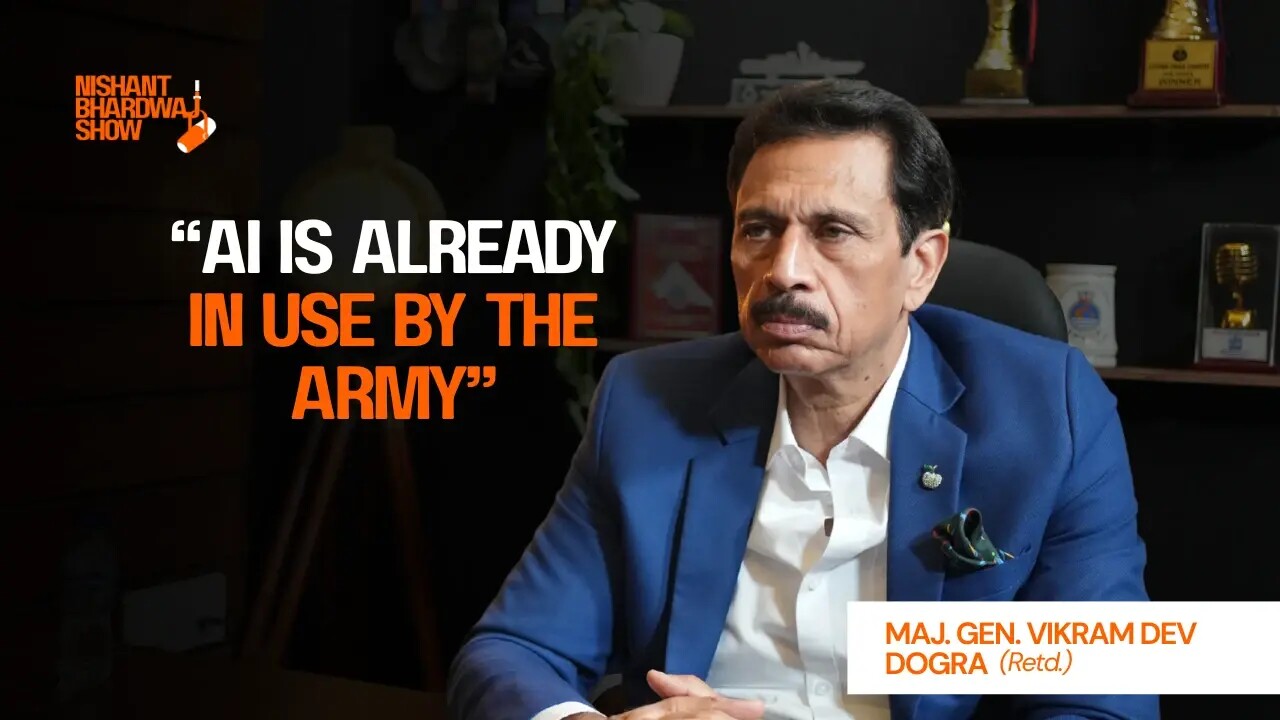
Can AI Win Wars? Future of AI in Defence | ft. Maj. Gen. Vikram Dogra | S7 Ep3
S07 · E03 · 1h 0m§ Keep reading

Communities: The Next Big Unlock for AI Marketing?
Moneka Khurana on AI fluency, brand visibility inside LLMs, human judgment, and the collective wisdom marketers need now.
Rewritten: How AI Is Quietly Redrawing Every Industry
Drawing from over 200 conversations with the world's leading operators, scientists and executives, Rewritten is the field guide to the most consequential rewrite of our economy. Coming 2026 from a major publisher.
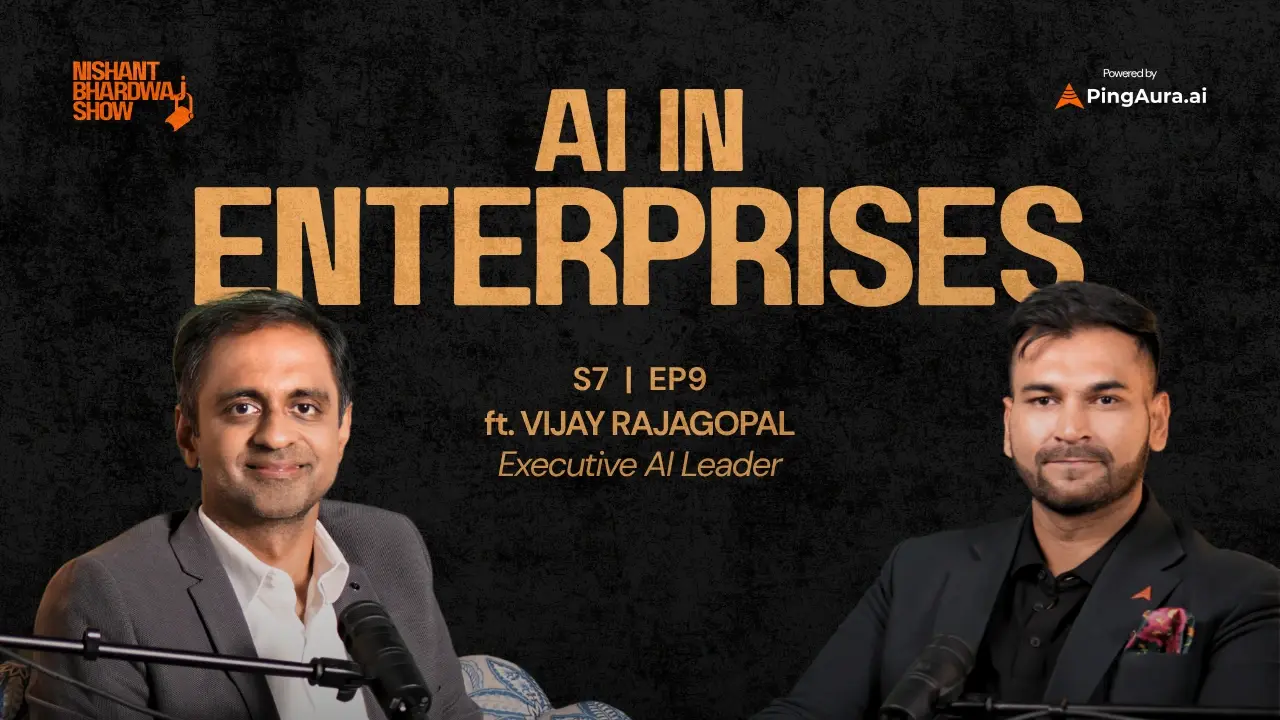
AI Will Not Replace Humans. Humans Who Use AI Will.
A private equity investor turned operator across Zeta, PayPal, Amazon Pay and AWS makes the case that the real risk in a career was never taking one.